New data highlight on investigating growth interactions in the human gut microbiome
Published: 2026-09-24
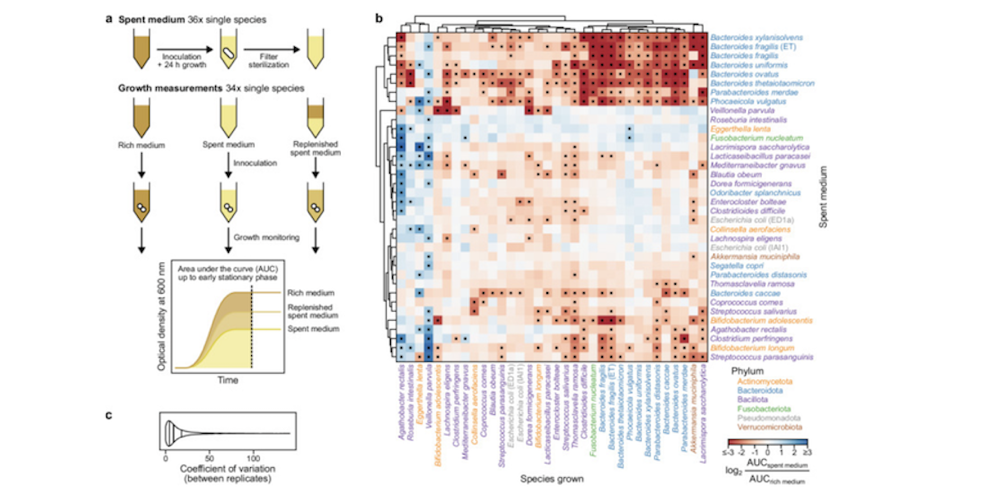
Our latest data highlight, “Investigating growth interactions in the human gut microbiome”, presents the work of Buyanbadrakh et al. (2026). This study systematically maps growth interactions among 36 representative bacterial strains from the human gut microbiome, providing a comprehensive dataset of how gut bacteria can inhibit or promote the growth of other species.
To systematically investigate these interactions, Buyanbadrakh et al. (2026) used a spent-medium approach to examine 1,224 binary interactions among gut bacterial strains spanning six major phyla. Most strong interactions were inhibitory; 307 interactions reduced growth by at least two-fold, compared with 51 that promoted growth. Nutrient replenishment reduced the number of inhibitory interactions more than eight-fold, indicating that resource depletion and changes to the extracellular environment are major drivers of growth inhibition.
The study also identified specific mechanisms underlying positive microbial interactions. For example, Clostridium perfringens promoted the growth of Mediterraneibacter gnavus through extracellular vesicles, demonstrating a potential mechanism for transferring growth-enhancing components between gut bacteria. In addition, Veillonella parvula was found to increase environmental pH and thereby rescue the growth of the acid-sensitive bacterium Parabacteroides merdae. This pH-modulating effect was enhanced by guanine and persisted in multi-species communities containing different acidifying bacteria.
By combining systematic interaction profiling with proteomics, metabolomics, and community experiments, this work provides both a valuable dataset of human gut bacterial interactions and mechanistic insights into how individual species can shape their microbial environment. The findings highlight how processes such as extracellular-vesicle-mediated interactions and local pH modulation can influence community composition, providing a foundation for predicting microbiome behaviour and developing strategies for the rational manipulation of gut microbial communities.
To find out more about the study, please read the data highlight.
If you are interested in having your work in the areas of pandemic preparedness and/or infectious disease promoted on the portal, please contact the portal team.