Exploring the Influenza vaccine effectiveness in European children
Published: 2026-05-22
Influenza is a highly contagious viral infection that causes significant morbidity in children, with approximately one in five unvaccinated children infected annually worldwide. Policies around childhood vaccination differ between countries in the European Union (EU) and Economic Area (EEA). All countries recommend that children at high risk of severe disease are vaccination, and some also recommend vaccination for particular age ranges.
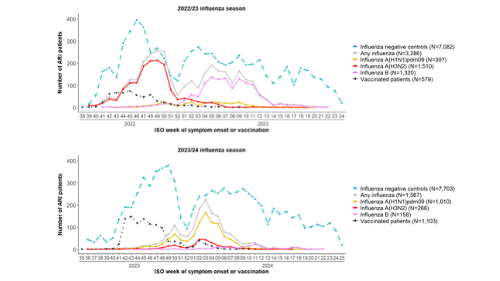
Lucaccioni et al. (2026) estimated influenza vaccine effectiveness (VE) among children (individuals under 18 years) attending primary care in Europe during the 2022-3 and 2023-4 influenza seasons. The study made use of the Vaccine Effectiveness, Burden and Impact Studies (VEBIS) multicenter network, which involves primary care practices across nine EU/EEA countries. It used a test-negative case control design; individuals testing positive were classified as cases, and those testing negative served as controls.
VE varied between years and subtypes. In total, almost 20,000 children were included in the study (10,368 in 2022-3, and 9,270 in 2023-4, with test positivity rates of 32% and 17%, respectively). VE against influenza overall was 68% and 71% in the first and second seasons, respectively. However, there was more variation between subtypes. For example, VE was found to be 54% against A(H3N2), and 83% against influenza B in the first season, where they were the predominant strains. The rates of VE against subtypes also differed between years, with differences linked to viral evolution and changes in vaccine composition.
VE also differed across age groups, with younger children generally showing higher rates than adolescents. Additionally, children in vaccination target groups (those with chronic conditions or age-based eligibility) showed similar levels of protection (~69–70%) compared to the overall population.
The study highlights the importance of continuous VE monitoring using primary care surveillance systems. By combining clinical data with laboratory confirmation, the test-negative design reduces bias related to healthcare-seeking behavior and provides robust real-world estimates of vaccine performance. However, limitations include missing data on prior vaccination history, potential partial vaccination in younger children, and variability in vaccination policies across countries.
Overall, Lucaccioni et al. (2026) demonstrates that influenza vaccination provides substantial protection against outpatient influenza in children across Europe. The findings support expanding vaccination coverage, particularly among high-risk groups, and emphasise the role of ongoing surveillance in optimising vaccination strategies.
Data
The supplementary material provides detailed methodological information, including study protocols, site-specific data collection procedures, vaccination target group definitions, and additional statistical analyses. It also contains extended tables and figures presenting patient characteristics, sensitivity analyses, and vaccine effectiveness estimates stratified by age group, influenza subtype, and study site to support and complement the main findings.
Article
Lucaccioni, H., Maurel, M., Pérez-Gimeno, G., et al. (2026). Influenza Vaccine Effectiveness in European Primary Care Pediatric Practices: 2022-2024. Pediatrics, 157(5), e2025072907.
Funding
This study has received funding from the European Centre for Disease Prevention and Control (ECDC) under framework contract ECDC/2021/019.