Antibiotic resistance does not recognise disciplinary borders: The Uppsala Antibiotic Center’s approach to research and education
Antibiotic resistance does not stay inside laboratories, hospitals, or policy documents. Resistant bacteria and resistance genes can move among people, animals, food systems, water, and the environment (Larsson and Flach, 2022). It can follow travel routes, supply chains, prescribing habits, and access to care. This is why antibiotic resistance cannot be solved from a single perspective. In fact, antibiotic resistance arguably cannot be solved at all (Wright, 2010), but managing it needs a shared responsibility, a shared language, and a shared space. This belief stands at the core of the Uppsala Antibiotic Center (UAC).
UAC works from a simple premise: no single discipline can understand, let alone reduce, the impact of antibiotic resistance on its own. The greatest risk today is not lack of knowledge, but the fragmentation among those advancing that knowledge. Knowledge that remains isolated loses power, while knowledge that travels across fields gains force (Okamura, 2019).
At UAC, linguists meet clinicians (Lindström and Tängdén, 2022), material scientists meet microbiologists (Sánchez Martín et al.. 2022), and pharmacists meet chemists (He et al., 2025), among many others. This vision is what shapes how we design projects, organise activities, and collaborate across Uppsala and beyond.
Moving from silos to shared questions
Many researchers traditionally work with clearly defined methods, tight research questions, and a strong disciplinary identity. That is a strength from an academic perspective, but, at the same time, it can limit the perspective on super-wicked problems such as antibiotic resistance (Littmann et al., 2020). One of our most important roles as a center is to widen the room so the competencies can synergise.
Solutions do not fail, for example, because we cannot sequence fast enough. But they will fail when fast diagnostic tests do not reach practice because a new technology is complicated to use, or too expensive to deploy. If the technical, clinical, social, and environmental aspects of current research stay disconnected, their potential for impact will be limited.
Since we started the center in 2016, we have seen a shift take place in the way our members think and work. Through our activities and opportunities for interaction, new ideas come up, projects are strengthened, and collaborations widen.
Education is our infrastructure for the future
A central part of UAC’s work is education as a long-term infrastructure for the field. Through our open research school we support PhD students and researchers with advanced courses, travel grants, mentorship, and access to national and international networks. From the start of their careers, they meet peers and senior researchers from across fields. They learn early that their work does not stand alone and is part of a big puzzle, painting a common picture among all of them; advancing knowledge to reduce the impact of resistance.
Students entering the field today will shape how resistance is handled in ten, twenty, and thirty years. Their training is essential to instill systems thinking and for them to become “specialists with a generalist touch” in the antibiotic resistance sphere. When education mirrors the real workflows of the problem, students start their professional careers better prepared for both research and societal impact.
Expanding the community to foster growth
The focus that UAC has had on students and early-career researchers will remain central, as it helps shape generations used to thinking beyond their own field and placing their work in a wider context. At the same time, a research community is incomplete by only focusing on those starting their careers.
UAC is now strengthening its engagement with more senior scientists, from postdoctoral researchers to retired professors. These researchers lead projects, mentor others, and turn ideas into practice, and we hope that providing a more stable meeting point will result in new research and collaborations. This direction reflects the goals set by UAC’s new director. The aim is to create spaces where more established researchers can meet across disciplines, test ideas at an early stage, and engage in open conversation rather than a polished presentation. In the spaces created by the UAC, curiosity matters as much as expertise.
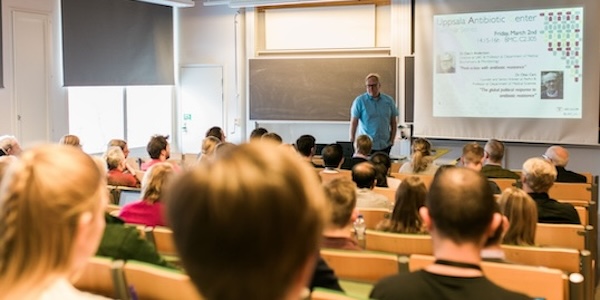
The Uppsala Antibiotic Days, our bi-annual international conference, plays an important role in this effort. The meeting brings together researchers, clinicians, policymakers, and industry across career stages. It offers time and space for dialogue, reflection, and new connections. Many collaborations have started there, and quite often through informal conversations.
If you work with antibiotic resistance and are looking for a community that grows with you, this is an invitation. We encourage you to take part, to contribute, and to help shape how the field moves forward.